Friday, June 12, 2015

Is it true?

As we said in our last post, making greener choices is not only good for the environment, but also for your wallet, and sometimes they’re good for your health too.

You don’t believe me, do you? Well, I don’t blame you because many people don’t know either. I’m talking about the cat litter market. How are these things related?


Although there are no studies on this issue, there is a controversy about the safety of clay cat litters that use sodium bentonite as their clumping ingredient. It is believed that clay particles can cause even death if a cat swallows them while licking their paws and fur, because they can expand and harden in the gastrointestinal tract. In addition to this, most clumping litters are considered toxic substances because they can induce abortion in humans.

We haven´t mentioned yet the consequences for the environment. The mass formed by clumping clay cat litters are non-biodegradable; therefore they do NOT decompose in landfills. So, let’s think of all the waste we’re throwing away. How many bags do you use in a month? I used about 2 bags of 6 kg each month, which is 144 kg in a year. That’s too much, don’t you think?


Fortunately, there are eco-friendly alternatives.  Each day, organic biodegradable cat litters are appearing in the market with new brands. This is the result of a new market niche. These alternative cat litters are made from: corn, wheat, wood fibers or shaving (pine and walnut pellets), volcanic rocks (zeolite), paper, among others.

 As you can see there is a wide range of cat litter alternatives chemical free, which are 100% natural and therefore is safe for landfill disposal. And also, they are NOT harmful to humans or cats.

But that is not all; they’re much cheaper than clay litters. Let’s compare:

I used to buy mainly two clumping cat litters: one is Super Mix of 7.5 kg which costs about CLP 7,000. But, my cat used 1 and ½ bags in a month, so I spent about CLP 14,000 every two months. The other one was Traper of 5 kg, which costs CLP 5,290. Whit this one, I also needed 2 bags per month. Once I bought Cat’s Pride litter (5,290), but it didn’t even last for 2 weeks!

What about the eco-friendly ones? Well, I compared prices in different supermarkets and home centers and there is a wide gap when compared to non-biodegradable litters. The prices of natural cat litters are very similar: CLP 1,790 (2 kg); 2,260 (2 kg); and 3,290 (2.5 kg). I bought the CLP 2,260 litter and I must say that it lasts longer than the clumping cat litter. I also had to buy 2 bags, but I saved CLP 9,480at the end.

So, what do you think? Do you take up the challenge? Try with an eco-friendly cat litter during 1 month and then share your experience with us!  


*Prices from: Easy, Homecenter Sodimac, Lider and Santa Isabel.
Sources:

A thought on pets


They are everywhere, in parks, on the streets and in almost every public space. Some of them are more exotic than others and some have been among us for thousands of years. Obviously, I’m talking about pets. We have to acknowledge their importance in our lives whether we see them as our companions, guardians, friends or another member of the family. 

The significance of their role can be observed in the increasing number of people that own animal companions (70% of Chileans decide to introduce a cat or dog into the 
household[1]) and the amount of money we are willing to spend on them. According to recent data, a dog owner spends up to 300,000 CLP per year in food, veterinary care, pet grooming and entertainment[2]. Bear in mind that this is only an estimate for dogs, this figure is likely to increase if you own exotic animals such as hedgehogs, iguanas, ferrets, etc. Having a pet is like having a child, you have to be aware or your responsibilities. If you want to have a pet, you must be sure of it because you most certainly will have to spend time and money on them. I just want to say one more thing on this subject: don’t purchase your pet. Even if the market allows you to do so. Nowadays, many people objectify their domestic animals, parading them around as a sign of economic accomplishment. Did you know that depending on the race you can pay CLP 80,000-3,000,000 for a dog? This frivolous act sends a terrible message to society. Pets are not goods. Pets are living beings capable of experiencing human-like feelings, we owe them respect. Besides, there are hundreds of abandoned animal companions that are just as likely to give you love and company. Choose wisely.


Thursday, June 11, 2015

Making greener choices


Would you like to be more eco-friendly but you don´t know where to start? I know that sometimes it may be difficult to start doing something new and making it part of your habits. But, what if we begin with something simple? Remember: try with one step a time! 

I can assure you that whit this easy and simple action you will be in the right way to go green.


I’m talking about replacing your traditional or incandescent light bulbs with energy-efficient ones, such as compact fluorescent lamps (CFLs) or light emitting diodes (LED). Today, I’m focusing on the CFLs because they have a greater presence in the Chilean market and also because they’re cheaper than LED light bulbs.


First of all, we should know, what’s the main difference between traditional bulbs and energy saving ones? The difference is the amount of energy they use to produce light and heat. 

 While, incandescent bulbs release 90% of their energy as heat and only 10% as light, CFLs produce light with 75% of the electricity they use. In fact, when compared to traditional bulbs, CFLs use 75% less energy.
http://inside.edison.com/g912 
As you might think, that waste of energy is money we’re throwing away. Lighting represents a high percentage of electricity consumption in households so, by replacing light bulbs you can reduce up to 80% of your electricity consumption. You will notice this on your bill each month. For example, if you just change the most used bulbs at home, you could save between 25% and 30% of electricity.

It’s true; CFLs are more expensive, but don’t worry because in the short term you will start saving money. An incandescent bulb of 75 Watts costs on average CLP 450, while the price of a CFL varies from CLP 2,290 to 3,290*. However, you should keep in mind that an energy-efficient bulb last 10 to 25 times longer than traditional ones. 

Let’s compare both bulbs in detail. Take a look at the following table:


Average lifespan (h)
Use (W)
Daily use (h)
Use kWh1
Cost (CLP)

daily
monthly
annual
daily
monthly
annual
Incandescent bulb
1,000
75
5
0.375
11.25
135
41.25
1,237.5
14,850
CFL
8,000
14
5
0.07
2.1
25.2
7.7
231
2,772


Annual cost (CLP)
Market price (CLP)
N° of bulbs needed for   8,000 h
Total cost (CLP)

Incandescent bulb
14,850
450
8
18,450
CFL
2,772
2,7902
1
5,562
1: Based on an electricity rate of CLP 110 per kilowatt-hour (Concepción may, 2016).
2: Average price.

By just replacing incandescent bulbs at home, you can save CLP 12,888 in a year. Not bad, isn’t it? We’ve already replaced all light bulbs. What are you waiting for?


What's that smell?

When we started this blog, we thought we’d only discuss environment-related issues.  And that’s been pretty amazing, I’m not going to say otherwise. But when I think about it, Going Green can be a lot more than that. In our Facebook page, we describe ourselves as ‘environmentally aware’ and that was supposed to mean that we take interest in the impact our life styles have on the environment. Nevertheless, I’ve come to the realization that this expression can have a wider meaning. The environment is not only “the natural world in which people, animals and plants live”[1], but also “the conditions that affect the behavior and development of someone or something”[2]. Why am I telling you this? Because in this occasion I want to write about a subject that falls into the second meaning of environment.

 The decriminalization and legalization of marijuana is a topic of debate that’s been in the public eye for years and hasn’t yet been entirely solved, even though it has been proven that penalization of cannabis consumption is not the way to win the war against drugs or an effective way of reducing its use. Take Chile, for example. Under Law 20.000, the Chilean regulation on drug use, marijuana is classified as a hard drug, which means that it’s at the same level as heroin and cocaine. And in spite of current regulations, the number of consumers has only grown higher over the past years. In fact, Chile has the highest rate of usage in the region according to the 2015 OAS Report on Drug use in the Americas. Drug policies like this one involve an elevated monetary cost. In 2012, more than 80,000 people were arrested on drug charges, 60% of them being charged with possession[3]. As a consequence, we have overcrowded prisons and the State spends millions of dollars a year in law enforcement.

If marijuana was legalized, the State would be able to regulate and monitor marijuana’s sale and by doing so, it could get its hands on tax revenues. In the US, annual marijuana trade is approximately USD 113 billion which, according to Harvard economist Jeffrey Miron, represents about USD 45 billion in taxes[4]. Marijuana legalization would also create jobs associated with cultivation, boosting the agricultural industry. Moreover, the industry of tourism could be revitalized. Think of Amsterdam for a second, the capital city of the Netherlands, where tourists travel from all over the world to visit the Coffeeshops, licensed establishments where you can legally buy cannabis products.  It’s high time we rethink prohibicionism if we want to benefit from marijuana legalization. Only then the grass will be greener on OUR side.


Monday, June 8, 2015

Change your bottle!


Would you like to save money, protect your health and the environment at the same time? Well, you have to do just ONE thing: CHANGE YOUR BOTTLE!
The worldwide bottled water consumption is severely damaging the planet. Did you know that about 3 million tons of plastics are used to produce water bottles? And that about 80% end up in landfills? 

During the last years, the plastic water bottle business has grown at a remarkable rate each year to become a US $100 billion industry. Only in Chile, the consumption of bottled water increased by more than 50% during the last decade. In 2013, bottled water consumption was 393 million liters. That is 22 liters per capita, while 10 years ago consumption was only 7 liters per person, according to the Association of Soft Drink Producers (Asociación Nacional de Bebidas Refrescantes - ANBER).


That’s  quite  impressive,  isn´t it? Now, you might be wondering what happens with all that plastic. Well, that’s where the problem lies. In fact, up to 25,000 plastic tons go into the ocean each year in Chile1.

This matter should concern all of us, because it’s a global issue. It’s not only the amount of plastic we’re throwing away, it’s the time that each PET bottle (polyethylene terephthalate) takes to decompose: between 100 and 1,000 years. 


Isn’t it too much time? And it gets worse. I haven’t even mentioned that 1 liter of bottled water can cost up to 1,000 times MORE than tap water, according to figures from UNESCO.

In the US a bottle of 750ml costs about CLP 950, while in Colombia it costs about CLP 2,517 and in Venezuela a bottle of 500ml costs about CLP 18,000. 


In Chile the price of 500ml of bottled water on average cost 750 CLP. This is incredibly expensive if we compare it with tap water, which costs 1 CLP on average.

Moreover, unlike what companies try to make us believe, municipal water is under the same and sometimes higher safety standards than bottled water. Actually, studies reveal that bottled water regulations are inadequate to ensure purity and safety. In the case of Chile, tap water is really safe. In fact, municipal water treatment has even stricter standards than those stated by the World Health Organization.


So, why do you want to be part of an industry that has more cons than pros? Why are you willing to pay so much for something when you can have it at home? Well, we’re not considering those countries where bottled water is a need because people have no access to safe water.

What are you waiting for? It’s time to make the change. Using reusable bottles it’s not only good for the environment, but also for your wallet. 


(1): According to the study “Plastic waste inputs from land into the ocean”, led by researchers of the University of Georgia.


Sources:
http://www.sofofa.cl/mantenedor/detalle.asp?p=60&s=6040&n=21360


Sunday, May 24, 2015

allGreenup is the way to go


Save money with allGreenup

The world is full of cynics who are more than willing to say almost anything in order to turn you into one of them. These are the same people that will tell you that recycling is a waste of time because Chile doesn’t have a real and global policy on recycling. They might even tell you that riding a bike to work or to university doesn’t make any difference at all and that you’re only doing it so that you can feel good about yourself. I say, boo hoo to them. Fortunately, there are still people whose existence is a contribution to making this world a better place. Sebastián and Andrés Luongo are part of this select group of people fighting to make a difference. These two Chilean cousins are the creators of a free revolutionary mobile app: allGreenup. 


allGreenup was launched in 2013, since then it has been installed more than 10,000 times.

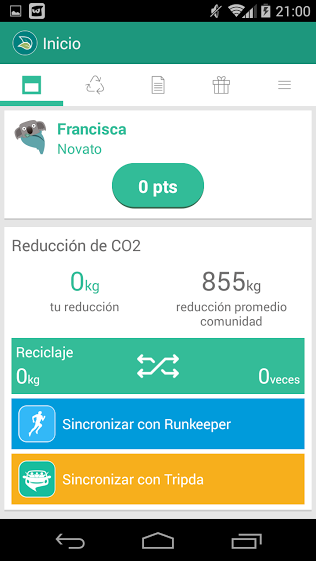
Do you want to save money while you help the environment? Then, this app is for you.  AllGreenup rewards users with attractive discounts or special offers if they take eco-friendly decisions such as recycling, riding a bike, carpooling or simply reading suggested articles. The app can even determine the environmental impact of the eco-friendly actions you take as it keeps a record of them. This is how it works: once you’ve registered to the app, you earn a number of points for each environmentally-friendly action you take. Here is when you probably wonder how this app finds out about your good deeds. The answer depends on your actions. 


Recycling point in Providencia, Santiago.

When recycling, you'll have to scan the QR codes located on the recycling points registered in the system if you are in Chile. Otherwise, you'll have activate the GPS in order to confirm that you are actually at a reciclyng point. If you find a recycling point that's not registered in the system, you can suggest its incorporation and this also gives you points. All in all, you can get 5 to 12 points depending on the material you recycle (plastic, glass, paper, cans, Tetra Pak packages, batteries, e-waste, cooking oil, CD's and DVD's). 


QR codes on recycling bins.
If you're going to run, walk or ride a bike to get to a destination, then allGreenup has to be syncronized with RunKeeper. This GPS-based app will keep track of the distance you’ve travelled and this information will be transferred to allGreenup once you’ve synchronized the two apps. Each kilometer gives you 3 points.  If you want to carpool, you'll have to install Tripda. You'll obtain 40 points for each time you carpool. Want to get more points? You can read environment-related articles which will give you 1 to 4 points. Once you’ve gathered enough points, you can go to the allGreenup store and trade them for goods, discounts and activities, all of them related to sustainability and the protection of the environment. Currently, there are more than 50 brands associated with this app. Among them: GAMA Bikes, Patagonia Camp and Clementina.

Screenshots on how allGreenup works (sadly, the app has only a Spanish version)


Friday, May 22, 2015

1 song, 1 shower


Hello there! Today I want to talk to you about an important issue nowadays, which is water waste and a really simple way to reduce its misuse, saving money at the same time.

We take for granted that water is a right and therefore it should be at our disposal. But this is no true! It’s widely known that water is the basis of all life. However, we just realize of their importance when water supply is cut off and we can’t do common activities such as going to the bathroom, cooking or doing the laundry.


Water is the most precious resource on earth, but unfortunately it is unevenly distributed around the world. Just for you to know, here are some facts:

Source: http://water.org/water-crisis/water-facts/water/
which means

Source: http://www.unwater.org/water-cooperation-2013/water-cooperation/facts-and-figures/en/

Another global issue is related with water scarcity. This problem is twofold: firstly, water use is growing way faster than the rate of population increase and secondly, water reserves are being used faster than they can be replenished.

Source: http://www.unwater.org/water-cooperation-2013/water-cooperation/facts-and-figures/en/

Isn’t this extremely unfair? Of course it is! This is the reason why having water in the comfort of our homes is a PRIVILEGE and; therefore we must be conscious and preserve this invaluable resource.  

But, how can we preserve it? Did you know that –roughly speaking– 70% of water use in households occurs indoors? Or that more than 60% of this use occurs in the bathroom? Take a look at this image:


As you may see in the picture, taking a shower is the activity in which we spent the highest amount of water in households. We spend about 200 liters of water in a ten-minute shower, on average, according to the World Health Organization. That is the daily amount of water that 14 persons need in a week.

Come to think of it, the time we spend while showering is an important topic and it should concern all of us. But, what can we do in order to reduce our daily water consumption?

I know that sometimes it may be difficult to include something new in our routine. But believe me; with this method you won’t have this problem. How do I know this? Because I started to use it some weeks ago and I can say that it works, well at least for me. It’s really simple.

The idea consists of reducing the time you spend in the shower, but in a funny way. The only thing you have to do is put a song when you’re going to take a shower and finish before the music is over. It’s easy, simple and you don’t even have to spend money on those faucet aerators.

With this method, you will reduce your daily showering time to a maximum of 5 minutes (about 60 liters of water). This will allow you to save up to 4.000 CLP* per month, which means significant savings for an average family. Keep in mind that this figure is just for one person, so imagine if another roommate applies the same strategy. This would mean 96.000 CLP in savings in a year. And yet we’re not considering your gas consumption, because this measure will also help you to reduce your gas bill. Make the counts!

Of course, it’s also a good idea to buy a water-saving low-flow shower head (faucet aerators) because it can reduce up to 50% in your water use. But in Going Green Now, we believe that any change starts with a change of perspective. First of all, we have to learn the importance of water in order to appreciate its value, and then we’ll really be conscious and reduce its use. Only then, our actions will be meaningful.