Thursday, June 11, 2015

What's that smell?

When we started this blog, we thought we’d only discuss environment-related issues.  And that’s been pretty amazing, I’m not going to say otherwise. But when I think about it, Going Green can be a lot more than that. In our Facebook page, we describe ourselves as ‘environmentally aware’ and that was supposed to mean that we take interest in the impact our life styles have on the environment. Nevertheless, I’ve come to the realization that this expression can have a wider meaning. The environment is not only “the natural world in which people, animals and plants live”[1], but also “the conditions that affect the behavior and development of someone or something”[2]. Why am I telling you this? Because in this occasion I want to write about a subject that falls into the second meaning of environment.

 The decriminalization and legalization of marijuana is a topic of debate that’s been in the public eye for years and hasn’t yet been entirely solved, even though it has been proven that penalization of cannabis consumption is not the way to win the war against drugs or an effective way of reducing its use. Take Chile, for example. Under Law 20.000, the Chilean regulation on drug use, marijuana is classified as a hard drug, which means that it’s at the same level as heroin and cocaine. And in spite of current regulations, the number of consumers has only grown higher over the past years. In fact, Chile has the highest rate of usage in the region according to the 2015 OAS Report on Drug use in the Americas. Drug policies like this one involve an elevated monetary cost. In 2012, more than 80,000 people were arrested on drug charges, 60% of them being charged with possession[3]. As a consequence, we have overcrowded prisons and the State spends millions of dollars a year in law enforcement.

If marijuana was legalized, the State would be able to regulate and monitor marijuana’s sale and by doing so, it could get its hands on tax revenues. In the US, annual marijuana trade is approximately USD 113 billion which, according to Harvard economist Jeffrey Miron, represents about USD 45 billion in taxes[4]. Marijuana legalization would also create jobs associated with cultivation, boosting the agricultural industry. Moreover, the industry of tourism could be revitalized. Think of Amsterdam for a second, the capital city of the Netherlands, where tourists travel from all over the world to visit the Coffeeshops, licensed establishments where you can legally buy cannabis products.  It’s high time we rethink prohibicionism if we want to benefit from marijuana legalization. Only then the grass will be greener on OUR side.


Monday, June 8, 2015

Change your bottle!


Would you like to save money, protect your health and the environment at the same time? Well, you have to do just ONE thing: CHANGE YOUR BOTTLE!
The worldwide bottled water consumption is severely damaging the planet. Did you know that about 3 million tons of plastics are used to produce water bottles? And that about 80% end up in landfills? 

During the last years, the plastic water bottle business has grown at a remarkable rate each year to become a US $100 billion industry. Only in Chile, the consumption of bottled water increased by more than 50% during the last decade. In 2013, bottled water consumption was 393 million liters. That is 22 liters per capita, while 10 years ago consumption was only 7 liters per person, according to the Association of Soft Drink Producers (Asociación Nacional de Bebidas Refrescantes - ANBER).


That’s  quite  impressive,  isn´t it? Now, you might be wondering what happens with all that plastic. Well, that’s where the problem lies. In fact, up to 25,000 plastic tons go into the ocean each year in Chile1.

This matter should concern all of us, because it’s a global issue. It’s not only the amount of plastic we’re throwing away, it’s the time that each PET bottle (polyethylene terephthalate) takes to decompose: between 100 and 1,000 years. 


Isn’t it too much time? And it gets worse. I haven’t even mentioned that 1 liter of bottled water can cost up to 1,000 times MORE than tap water, according to figures from UNESCO.

In the US a bottle of 750ml costs about CLP 950, while in Colombia it costs about CLP 2,517 and in Venezuela a bottle of 500ml costs about CLP 18,000. 


In Chile the price of 500ml of bottled water on average cost 750 CLP. This is incredibly expensive if we compare it with tap water, which costs 1 CLP on average.

Moreover, unlike what companies try to make us believe, municipal water is under the same and sometimes higher safety standards than bottled water. Actually, studies reveal that bottled water regulations are inadequate to ensure purity and safety. In the case of Chile, tap water is really safe. In fact, municipal water treatment has even stricter standards than those stated by the World Health Organization.


So, why do you want to be part of an industry that has more cons than pros? Why are you willing to pay so much for something when you can have it at home? Well, we’re not considering those countries where bottled water is a need because people have no access to safe water.

What are you waiting for? It’s time to make the change. Using reusable bottles it’s not only good for the environment, but also for your wallet. 


(1): According to the study “Plastic waste inputs from land into the ocean”, led by researchers of the University of Georgia.


Sources:
http://www.sofofa.cl/mantenedor/detalle.asp?p=60&s=6040&n=21360


Sunday, May 24, 2015

allGreenup is the way to go


Save money with allGreenup

The world is full of cynics who are more than willing to say almost anything in order to turn you into one of them. These are the same people that will tell you that recycling is a waste of time because Chile doesn’t have a real and global policy on recycling. They might even tell you that riding a bike to work or to university doesn’t make any difference at all and that you’re only doing it so that you can feel good about yourself. I say, boo hoo to them. Fortunately, there are still people whose existence is a contribution to making this world a better place. Sebastián and Andrés Luongo are part of this select group of people fighting to make a difference. These two Chilean cousins are the creators of a free revolutionary mobile app: allGreenup. 


allGreenup was launched in 2013, since then it has been installed more than 10,000 times.

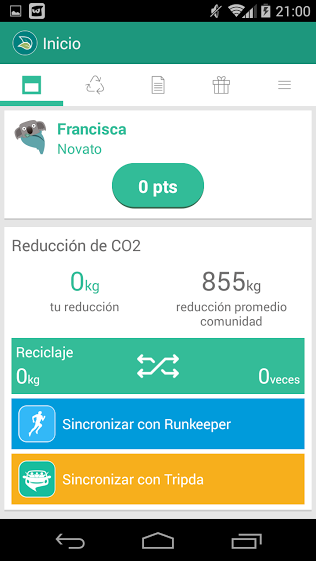
Do you want to save money while you help the environment? Then, this app is for you.  AllGreenup rewards users with attractive discounts or special offers if they take eco-friendly decisions such as recycling, riding a bike, carpooling or simply reading suggested articles. The app can even determine the environmental impact of the eco-friendly actions you take as it keeps a record of them. This is how it works: once you’ve registered to the app, you earn a number of points for each environmentally-friendly action you take. Here is when you probably wonder how this app finds out about your good deeds. The answer depends on your actions. 


Recycling point in Providencia, Santiago.

When recycling, you'll have to scan the QR codes located on the recycling points registered in the system if you are in Chile. Otherwise, you'll have activate the GPS in order to confirm that you are actually at a reciclyng point. If you find a recycling point that's not registered in the system, you can suggest its incorporation and this also gives you points. All in all, you can get 5 to 12 points depending on the material you recycle (plastic, glass, paper, cans, Tetra Pak packages, batteries, e-waste, cooking oil, CD's and DVD's). 


QR codes on recycling bins.
If you're going to run, walk or ride a bike to get to a destination, then allGreenup has to be syncronized with RunKeeper. This GPS-based app will keep track of the distance you’ve travelled and this information will be transferred to allGreenup once you’ve synchronized the two apps. Each kilometer gives you 3 points.  If you want to carpool, you'll have to install Tripda. You'll obtain 40 points for each time you carpool. Want to get more points? You can read environment-related articles which will give you 1 to 4 points. Once you’ve gathered enough points, you can go to the allGreenup store and trade them for goods, discounts and activities, all of them related to sustainability and the protection of the environment. Currently, there are more than 50 brands associated with this app. Among them: GAMA Bikes, Patagonia Camp and Clementina.

Screenshots on how allGreenup works (sadly, the app has only a Spanish version)


Friday, May 22, 2015

1 song, 1 shower


Hello there! Today I want to talk to you about an important issue nowadays, which is water waste and a really simple way to reduce its misuse, saving money at the same time.

We take for granted that water is a right and therefore it should be at our disposal. But this is no true! It’s widely known that water is the basis of all life. However, we just realize of their importance when water supply is cut off and we can’t do common activities such as going to the bathroom, cooking or doing the laundry.


Water is the most precious resource on earth, but unfortunately it is unevenly distributed around the world. Just for you to know, here are some facts:

Source: http://water.org/water-crisis/water-facts/water/
which means

Source: http://www.unwater.org/water-cooperation-2013/water-cooperation/facts-and-figures/en/

Another global issue is related with water scarcity. This problem is twofold: firstly, water use is growing way faster than the rate of population increase and secondly, water reserves are being used faster than they can be replenished.

Source: http://www.unwater.org/water-cooperation-2013/water-cooperation/facts-and-figures/en/

Isn’t this extremely unfair? Of course it is! This is the reason why having water in the comfort of our homes is a PRIVILEGE and; therefore we must be conscious and preserve this invaluable resource.  

But, how can we preserve it? Did you know that –roughly speaking– 70% of water use in households occurs indoors? Or that more than 60% of this use occurs in the bathroom? Take a look at this image:


As you may see in the picture, taking a shower is the activity in which we spent the highest amount of water in households. We spend about 200 liters of water in a ten-minute shower, on average, according to the World Health Organization. That is the daily amount of water that 14 persons need in a week.

Come to think of it, the time we spend while showering is an important topic and it should concern all of us. But, what can we do in order to reduce our daily water consumption?

I know that sometimes it may be difficult to include something new in our routine. But believe me; with this method you won’t have this problem. How do I know this? Because I started to use it some weeks ago and I can say that it works, well at least for me. It’s really simple.

The idea consists of reducing the time you spend in the shower, but in a funny way. The only thing you have to do is put a song when you’re going to take a shower and finish before the music is over. It’s easy, simple and you don’t even have to spend money on those faucet aerators.

With this method, you will reduce your daily showering time to a maximum of 5 minutes (about 60 liters of water). This will allow you to save up to 4.000 CLP* per month, which means significant savings for an average family. Keep in mind that this figure is just for one person, so imagine if another roommate applies the same strategy. This would mean 96.000 CLP in savings in a year. And yet we’re not considering your gas consumption, because this measure will also help you to reduce your gas bill. Make the counts!

Of course, it’s also a good idea to buy a water-saving low-flow shower head (faucet aerators) because it can reduce up to 50% in your water use. But in Going Green Now, we believe that any change starts with a change of perspective. First of all, we have to learn the importance of water in order to appreciate its value, and then we’ll really be conscious and reduce its use. Only then, our actions will be meaningful. 


Monday, April 27, 2015

For our second post, we would like to continue  talking about the situation of plastic bags in our country because we want you to realize the critical situation we’re going through. You probably have read or heard about the “Plastic Bag Reduction Ordinance” that some regions started to implement. Well, you might think why this? Why now?  

In case you didn’t know, our country has the highest production of solid waste in Latin America but only 10% of garbage is recycled. If we only consider the use of plastic carryout bags, more than 3 millions are being used every year, that is, 200 plastic bags per person which generally end up in landfills or public spaces such as squares, even in tourist places like national parks.


For this reason, we saw mainly supermarkets promoting a more environmentally friendly alternative. The nonwoven fabric bags spread quickly and today not only supermarkets but also shoes and departmental stores have replaced the traditional plastic bag by reusable shopping ones.


As my partner pointed out in the previous post, the case of Chile is not different from what happened in many other countries. The popularity of reusable bags has reached such a level that a new niche product has been created. Consequently, several small and medium-sized enterprises have emerged; some of which are expanding abroad. This is something beneficial for the economy and the environment; however, there are other aspects to take into consideration when it comes to the disadvantages such as the monetary cost for users.

We may all agree that plastic bags are like a plague difficult to eradicate and that any attempt to reduce their use has only positive aspects. Nevertheless, there is one thing I’m concerned about: The price of reusable bags. At the beginning, supermarkets sold these bags at $100 CLP then at $290 and now they cost $800 in some places.

You might think that $800 CLP is not that much, but if we think about this when doing the grocery shopping, we usually need more that one carrier bag. Therefore, we have to spend about $1600 or 2400 CLP additionally only in bags because –and let’s admit this– most Chileans are not accustomed to bring their own bags when shopping.  


This may not look like a big deal; even so, spending $2400 in carrier bags seems a considerable amount of money when we consider that about 50% of Chilean workers earn the minimum wage and that they would spend that money on other needs. Besides, what it bothers me the most is the fact that supermarkets are taking advantage of this situation. 

Don’t get me wrong, I’m not against reusable bags! But, why do they increase prices so often? In just a few months supermarkets increased the price of bags eight times their initial cost and given the fact that so far no one has said the opposite, now I’m wondering, are they continuing to rise?


From my perspective, I don’t see the point in restricting the use of plastic bags –which had no cost for consumers– and imposing a new system that is advantageous to companies. In order to make a major change in our habits, first of all, I would suggest that bags shouldn’t be so expensive and secondly, that the government or even supermarkets should create a strong campaign for raising people’s awareness about the importance of reusable shopping bags.